
Soil Production on a Shoe String
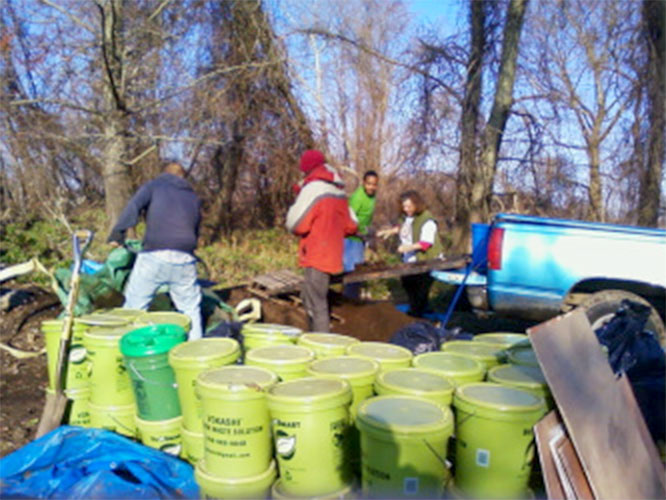
In the Fall of 2011, Vokashi began a pilot soil amendment project at it's Compost Demonstration Site located at the Marine Park Golf Course. In two 3'x6' trenches we mixed our fermented food waste with very sandy dirt to see how long it would take to improve the organic content of the soil. For three months we added buckets to these trenches and took soil samples to the Environmental Science Analytical Center (ESAC) at Brooklyn College for testing. There was enough improvement over the months to suggest trying the next volume of soil.
In the Spring we filled a 3 cu. yd. Bagster with a mixture of fermented food waste, sawdust from local cabinet makers and the very sandy dirt. We covered it and left it for two months to cure. Then the bag was opened and the decomposed material sifted. We had our first batch of "enriched" soil. Samples were sent to ESAC and again the results showed significant improvement in organic content.
Summer of Samples
We met Nick Lee, a high school student intern at ESAC. He needed a soil study so we developed a "shoe string" project for him: what is the optimum mixture of fermented food waste to sawdust/yard waste to soil. We created eight different sets of "mixtures" and Nick took the samples and processed them and completed his course work including a written report.
Meanwhile, we established two corals each with a 3 cu. yd. Bagster, filling them on alternative months with the combination of fermented food waste, sawdust and sandy soil and harvesting each after two months. Samples of this "enriched" soil are regularly sent to ESAC for testing as we refine the search for the optimum mixture of fermented food waste / sawdust / soil.
Two Wastes Diverted from Landfill
The most important breakthrough for Vokashi this year is the addition of sawdust from local cabinet makers – another waste often commingled with regular trash and sent to landfills. Combining sawdust with fermented food waste has helped the material decompose rapidly. Literally what remains on our sifter after two months are bones, peels and pits and some cardboard.
I am excited about adding EM-1 directly to sawdust that could then be used in larger bioremediation sites…–Vandra Thorburn
I am excited about adding EM-1 directly to sawdust that could then be used in larger bioremediation sites…–Vandra Thorburn
I am excited about adding EM-1 ® directly to sawdust that could then be used in larger bioremediation sites, as I am excited about the potential for expanding our soil production and traditional composting activities in community gardens and other private and public green spaces.
And finally, I must share my deep gratitude to the management at the Marine Park Golf Course and to Dr. Joshua Cheng and his students at ESAC. We are working hard to develop tests and demonstrations to provide data showing the efficacy of these good microorganisms in managing our food waste and building good compost and soils.

Vandra, I like the name “An Eco-Living Compost Service,” yet I still think that the fermentation and the virtually no smell and no insects milling around the bucket are real “WINS” and need to be stressed more and more. From my perspective, this is radically different from conventional composting. New Yorkers should know about your service and why it is different. I know. The same old mantra. Best, Regina
Actually struggle a lot with using word ‘compost’. You are right that we are actually fermenting our food scraps. However, the generic terms for managing food scraps seems to be the verb “compost.” There are those in the bokashi world that would like to introduce the verb bokashi as the thing that we do. Actually, there are subscribers who use ‘vokashi’ as the verb.. Let’s see how we grow. For time being I like to use compost because that’s what most people use when they are managing food scraps.